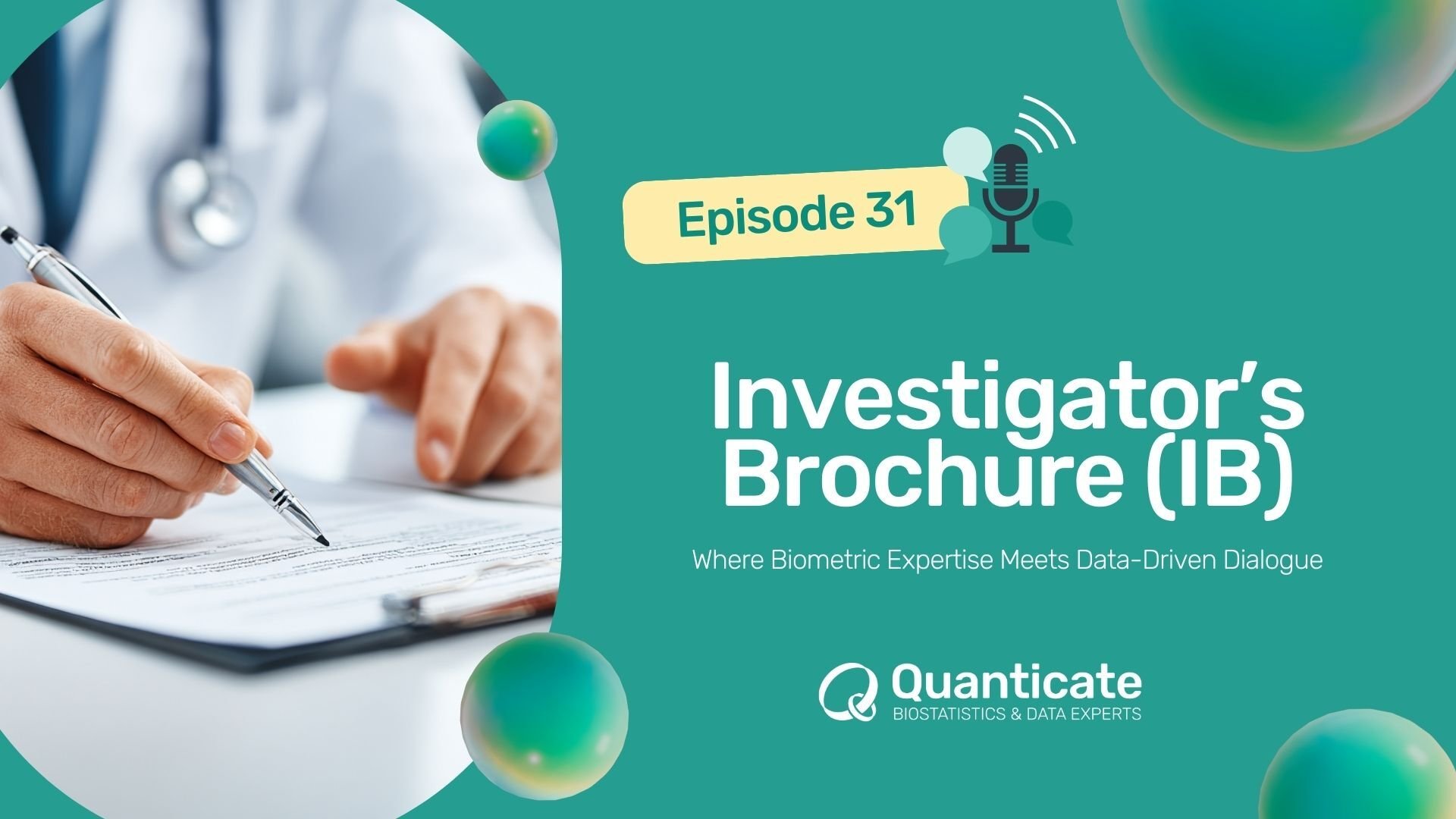
In this QCast episode, co-hosts Jullia and Tom unpack the Investigator’s Brochure (IB) and why it remains one of the most operationally important documents in clinical development. They clarify what an IB is meant to do in practice: bring together the evolving clinical and non-clinical evidence for an investigational product and translate it into usable guidance that supports safe conduct across sites. The discussion focuses on how an IB complements the protocol, what makes it genuinely usable for investigators working at pace, and the governance foundations that keep it reliable as new data emerges, including clear version control, aligned updates, and careful handling of Reference Safety Information (RSI) used for expectedness in expedited safety reporting.
🎧 Listen to the Episode:
Key Takeaways
What an Investigator’s Brochure Is and Why It Matters
An Investigator’s Brochure is a concise, objective, and balanced compilation of what’s known about an investigational product, including non-clinical and clinical experience where available. Its value is practical: it supports the risk and benefit assessment and helps investigators understand why the protocol takes a particular approach to dosing, administration, monitoring, and safety management. In multi-site studies, a well-structured IB also reduces avoidable variation by giving sites a consistent reference point for interpreting risks and applying precautions.
How an IB Works in Practice
The most effective IBs are built for scanning and decision-making. They make key messages easy to find, starting with clear document control, a usable contents page, and a short summary that highlights the most relevant risks and practical considerations. Core sections typically cover background and product properties, non-clinical pharmacology and toxicology, and human experience as available, then move into a dedicated area that turns evidence into action for the investigator. That action-oriented guidance is where dosing rationale, anticipated safety signals, and monitoring expectations become concrete enough to support day-to-day oversight at site level, without forcing investigators to interpret raw data under time pressure.
Limitations, Governance, and Best Practices
IB quality often fails in predictable ways: misalignment with the protocol, excessive length that buries guidance, and weak change control that leaves sites unsure what changed and when. Sponsors should review the IB at least annually, but also update it out of cycle when significant new safety information emerges, with clear data cut-offs and a succinct change history that makes differences easy to spot. Practical safeguards include keeping protocol and IB language consistent on dosing and monitoring, prioritising clarity over volume, and ensuring distribution and acknowledgement processes are robust so sites are working from the current version. Where RSI is included for expectedness assessment in expedited reporting, it needs especially clear placement, stable terminology, and strict version control, because expectedness decisions carry real regulatory and safety consequences. When those governance basics are in place, the IB functions as a living operational tool that supports trial integrity, rather than a static deliverable that’s hard to use when it matters most.
Full Transcript
Jullia
Welcome to QCast, the show where biometric expertise meets data-driven dialogue. I’m Jullia.
Tom
I’m Tom, and in each episode, we dive into the methodologies, case studies, regulatory shifts, and industry trends shaping modern drug development.
Jullia
Whether you’re in biotech, pharma or life sciences, we’re here to bring you practical insights straight from a leading biometrics CRO. Let’s get started.
Tom
Today we’re talking about the Investigator’s Brochure, or IB. Jullia, how would you define an IB, and who is it really written for?
Jullia
So, an Investigator’s Brochure is a compiled set of clinical and non-clinical data about an investigational product, often shortened to IP. The key is that it’s written to be concise, objective, and balanced, so it supports real decisions at site level. It’s primarily for the investigator and the site team, but it’s also used by ethics committees, institutional review boards, and sponsor oversight teams. Practically, it helps people understand what’s known about the product and how that should shape dosing, administration, monitoring, and response to adverse events. If the protocol tells you what to do, the IB explains why that approach is reasonable, based on the evidence available at that point in development.
Tom
So, why is the IB treated as such a central document, rather than just background reading? What does it enable that the protocol alone doesn’t?
Jullia
It anchors the risk and benefit assessment in a controlled, traceable way. The protocol is specific to a study design, but the IB connects the broader product evidence base to safe conduct across investigators and sites. Here it explains the rationale for the starting dose, any escalation or de-escalation logic, the dosing interval, and the route of administration. It also sets expectations for what safety signals might look like and what monitoring is needed. That can include pharmacokinetics and pharmacodynamics, shortened to PK and PD, plus the key laboratory tests and observations that help teams manage risk. Another point is consistency. If you have multiple sites, sometimes across regions, the IB helps make sure everyone is working from the same understanding of the product’s known risks. Done well, it reduces avoidable deviations driven by uncertainty or inconsistent interpretation.
Tom
Now you mentioned it has to be controlled and traceable so let’s talk responsibility. Who owns the IB, and how often should it change?
Jullia
See the sponsor is responsible for preparing the IB, or ensuring there's a current IB available, and for making sure investigators receive updates as evidence evolves. Investigators, on their side, are responsible for using the current version, applying it to their safety oversight, and integrating the relevant information into site and informed consent processes. In terms of cadence, current guidance expects the IB to be reviewed at least annually, but it’s not just an annual exercise. If new significant safety information emerges, you need an out-of-cycle update and timely communication because the point is to keep the document current. As for the UK and EU context, the submission pathway depends on the jurisdiction and the nature of the change, and some updates, especially those affecting how expectedness is assessed, may need review through the applicable amendment process.
Tom
Now people often ask what an IB actually contains. If you had to describe the structure, what are the core sections that make it usable for someone working at pace?
Jullia
So, a usable IB is built for scanning and for decision-making. It usually starts with clear front matter, including product identifiers, version number, and a confidentiality statement, then a table of contents that actually helps you find things. A short summary is essential, because most users need the headline risks, key findings, and practical guidance quickly. After that, there’s typically an introduction and background, then product properties and formulation where relevant. This is followed by non-clinical data and human clinical experience as available. Non-clinical often includes pharmacology and toxicology, and it may cover ADME. This means absorption, distribution, metabolism, and excretion, depending on the product. Then you get a dedicated safety section, and importantly, a section that translates evidence into action. You’ll often see it called a ‘Summary of Data and Guidance for the Investigator’. That’s where the IB earns its keep, because it turns information into monitoring expectations, precautions, and practical steps.
Tom
Now let’s give some practical advice. For someone listening who's either updating an IB or relying on one currently, what are some quick wins and the common pitfalls to watch for?
Jullia
Now if I was in that position, here’s what I would take away and look out for. First, check currency. Confirm you have the latest version and look for a clear data cut-off and a change history so you know what’s new. Second, keep the IB aligned with the protocol. If the dosing, monitoring, or stopping criteria differ between documents, sites lose time, and you risk deviations. Third, protect usability. A common pitfall is bloat, where the IB becomes a data dump and the guidance gets buried. Aim for concise summaries and clear headings, with tables where they genuinely help interpretation. Fourth, get distribution and acknowledgement right. Weak version control is a quiet risk, because a perfect update is useless if sites don’t receive it and understand what changed. And finally, keep the tone objective and non-promotional. The IB has to support an unbiased view of risk and safe use, so vague or sales-like language undermines confidence and can create confusion in everyday decisions.
Tom
In the UK and Europe there’s also a lot of focus on Reference Safety Information, or RSI. How does RSI fit into the IB and why does it get so much attention?
Jullia
So, Reference Safety Information, or RSI, is critical because it’s the sponsor’s reference for determining expectedness when assessing suspected serious adverse reactions for expedited reporting. This is especially so where applicable regulatory requirements apply. A serious adverse reaction, shortened to SAR, is an adverse reaction that is serious in nature. If a suspected serious adverse reaction is unexpected against the RSI, it may qualify as a suspected unexpected serious adverse reaction, or SUSAR, which can trigger expedited reporting obligations. Now RSI is typically set out clearly within the IB, so there’s no ambiguity about what’s considered expected for reporting purposes. The reason it gets attention is simple. Expectedness decisions have real regulatory and safety consequences. That means RSI needs strict version control, clear placement, and well-defined terminology. It’s also important to use consistent coding, often with MedDRA, so the expectedness logic is reliable and less prone to interpretation errors.
Tom
And that brings us back to updates. Now what tends to trigger an out-of-cycle IB update, and how do teams keep that process from becoming chaotic?
Jullia
Now the classic triggers are new significant safety signals, serious adverse reactions, important findings from non-clinical studies, or meaningful changes in what’s learned from ongoing clinical experience or marketed use, wherever that applies. The point isn’t to update for every minor data point. Rather, it's to update when the new information could change the risk and benefit assessment, monitoring, consent or trial conduct. To keep it controlled, teams need a defined change management process. This includes, documenting the rationale for the update, setting a clear data cut-off, capturing what changed in a concise change summary, and maintaining distribution logs. It also helps to align the IB update cycle with related safety deliverables where possible, so you’re not creating conflicting versions across documents. Finally, involve medically qualified review early, because the safety interpretation and how it’s expressed matters as much as the data itself.
Tom
Now the conversation so far has been focused on medicine, but trials also involve devices and combination products. Does the IB concept translate cleanly or do teams need to think differently?
Jullia
Well the concept translates, but the content has to adapt to the risk profile. For medical devices, the risks may be mechanical, electrical, software-related, or tied to human factors and how the device is used rather than pharmacological effects. So the IB, or an equivalent product information pack in some contexts, needs to describe the device design, intended use, materials, training requirements, and what failure modes look like. You may also need more emphasis on bench testing, software versioning, and performance monitoring. For combination products, you’ve got to cover both the medicinal and device elements, and how they interact, like a device delivering a drug or influencing exposure. Across both, version control becomes even more important, because a device software update can change risk in a way that sites must understand quickly. All in all, the principle stays the same. Clear, balanced evidence plus practical guidance that supports safe conduct.
Tom
Now before we wrap, can you pull the key threads together? If someone remembers only a few things about the IB, what should they be?
Jullia
So there’s three points worth holding onto. First, the IB is not just background, it’s a living, controlled document that connects the product evidence base to safe trial conduct. Second, it should make the evidence actionable, so investigators can interpret risks, monitor appropriately, and respond consistently across sites. Third, governance is where IBs succeed or fail. It all banks on clear version control, reliable distribution and timely updates when significant new safety information emerges. If teams get those right, the IB becomes a practical tool that supports day to day oversight.
Jullia
With that, we’ve come to the end of today’s episode on the Investigator’s Brochure. If you found this discussion useful, don’t forget to subscribe to QCast so you never miss an episode and share it with a colleague. And if you’d like to learn more about how Quanticate supports data-driven solutions in clinical trials, head to our website or get in touch.
Tom
Thanks for tuning in, and we’ll see you in the next episode.
About QCast
QCast by Quanticate is the podcast for biotech, pharma, and life science leaders looking to deepen their understanding of biometrics and modern drug development. Join co-hosts Tom and Jullia as they explore methodologies, case studies, regulatory shifts, and industry trends shaping the future of clinical research. Where biometric expertise meets data-driven dialogue, QCast delivers practical insights and thought leadership to inform your next breakthrough.
Subscribe to QCast on Apple Podcasts or Spotify to never miss an episode.



.png?width=110&name=ACDM_Corporate_Member_Badge_135%20(3).png)
.png?width=140&name=cdisc_gold_partner_80h%20(2).png)
