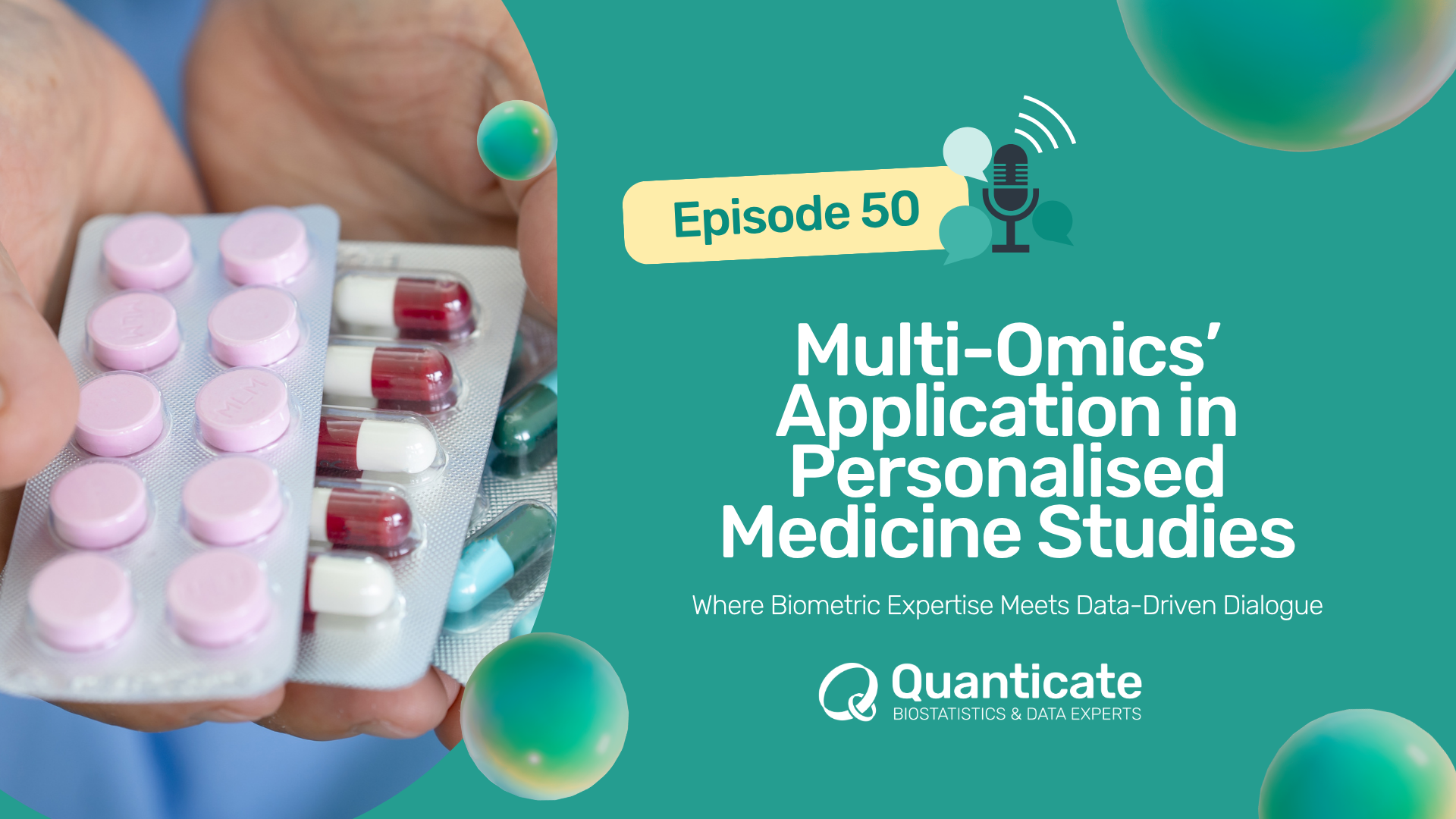
Multi-omics is becoming increasingly relevant to personalised medicine studies because it allows researchers to analyse several layers of biological data together, rather than relying on one type of signal alone. In this QCast episode, co-hosts Jullia and Tom discuss how genomics, transcriptomics, proteomics, metabolomics and related data types can help clinical teams understand disease mechanisms, treatment response and patient subgroup differences in more detail.
The episode also looks at the practical pressure points that come with multi-omics research. More biological data does not automatically lead to better answers. Study teams need clear clinical questions, careful sample planning, appropriate statistical methods, consistent data linkage and cautious interpretation. These details matter because multi-omics findings may influence biomarker analysis, patient stratification, endpoint interpretation and future study design.
🎧 Listen to the Episode:
Key Takeaways
Why multi-omics needs a clear clinical question
Multi-omics can generate large and complex datasets, but the value depends on how well the analysis is directed. A clear clinical or biological question helps determine which data layers are needed, how samples should be collected, and which statistical methods are appropriate. Without that focus, the analysis may identify patterns that are difficult to interpret or apply.
How multi-omics supports personalised medicine studies
Personalised medicine depends on understanding why patients differ in disease risk, treatment response or safety profile. Multi-omics can support this by linking molecular signals to clinical outcomes, helping researchers explore biomarkers, classify patient subgroups and assess whether a treatment may be more relevant for one population than another. The findings still need validation before they can support clinical decisions.
Where trial operations affect multi-omics analysis
The quality of a multi-omics analysis is shaped by ordinary trial delivery details. Sample timing, visit schedules, subject identifiers, lab data transfers, missing data and protocol deviations can all affect whether biological signals can be interpreted correctly. Planning these elements early helps ensure that molecular data can be linked back to outcomes such as response, progression or adverse events.
Full Transcript
Jullia
Welcome to QCast, the show where biometric expertise meets data-driven dialogue. I’m Jullia.
Tom
I’m Tom, and in each episode, we dive into the methodologies, case studies, regulatory shifts, and industry trends shaping modern drug development.
Jullia
Whether you’re in biotech, pharma or life sciences, we’re here to bring you practical insights straight from a leading biometrics CRO. Let’s get started.
Tom
Today we’re talking about multi-omics and its application in personalised medicine studies. What does it actually mean?
Jullia
Multi-omics means analysing several layers of biological data together, rather than looking at one layer on its own.
Those layers can include genomics, which looks at genetic variation, transcriptomics, which looks at gene expression, proteomics, which looks at proteins, and metabolomics, which looks at small molecules linked to metabolism. Epigenomics can also be involved, looking at changes that affect how genes are regulated.
The point is that disease, risk and treatment response are rarely explained by one biological signal. Multi-omics gives researchers a way to connect those signals.
Tom
So it’s trying to understand how the layers relate to each other?
Jullia
Exactly. A genetic variant might suggest a patient has a certain risk profile, but that doesn't always tell you whether a pathway is active, proteins are changing, or metabolism is being affected.
When those layers are analysed together, the picture can become more informative. That’s why multi-omics is relevant to personalised medicine. It can help researchers understand why one patient group may respond differently from another, or why one subgroup may be more likely to experience certain safety issues.
Tom
And personalised medicine, in this context, means matching treatment or prevention more closely to the patient?
Jullia
Yes. It means using patient characteristics to guide prevention, diagnosis or treatment. Those characteristics may be genetic, molecular, environmental or clinical.
So in a trial, that might mean looking for signals that help identify likely responders, patients at higher risk of progression, or patients who may need closer safety monitoring.
Oncology is a familiar example. Tumours may be classified not only by where they are in the body, but by their molecular profile. Multi-omics can help identify mutations, protein markers or metabolic patterns that make a targeted therapy more relevant for a particular subgroup.
Tom
Could you make that more concrete in terms of trial activity?
Jullia
Think about a study where samples are collected at baseline and again after treatment. Alongside clinical assessments, the study may collect genomic, proteomic or metabolomic data.
During analysis, the team might look for molecular signatures linked to response. One group may show a stronger response because a pathway is affected by the treatment. Another group may show a different safety profile because of a separate biological feature.
That can inform exploratory biomarker analysis, patient stratification, endpoint interpretation, or the design of a later study.
Tom
A common misconception is that more biological data automatically means better answers. Is that where teams need to be cautious?
Jullia
Yes, because multi-omics data can be very large and very complex. You may be dealing with thousands, or even millions, of variables.
The challenge is separating meaningful biological signals from noise. That needs a clear clinical question, careful data processing, and strong statistical planning.
Compatibility is also an issue. Different omics layers may come from different platforms, laboratories, sample types or processing pipelines. If those differences are not understood, the analysis can become difficult to interpret.
Tom
So you’re saying that statistical thinking needs to be built in early.
Jullia
Pretty much. Researchers may use methods such as Bayesian integration, network analysis, dimensionality reduction and machine learning to combine and explore different data types. Models such as regression models, mixed-effects models and generalised linear models can also be used to link omics data with clinical outcomes.
The method depends on the question. Are you exploring a possible biomarker? Predicting treatment response? Looking for a subgroup? Each aim needs a different level of evidence and a different approach to uncertainty.
Tom
So where does machine learning fit, and where can it cause problems?
Jullia
Machine learning can help identify patterns in complex datasets, especially when relationships are not simple or linear. It may be used to classify patients, predict response, or explore combinations of markers.
The risk is overfitting. A model can look strong in one dataset, then perform poorly in another. Interpretability also matters. If a model cannot be explained, it may be difficult to judge whether the result is biologically plausible or clinically useful.
So the question is whether that pattern is reproducible, meaningful and supported by enough evidence.
Tom
You mentioned biomarkers earlier. How does multi-omics help there?
Jullia
It can support biomarker discovery by looking across several biological levels at once. A protein marker in blood might be linked to disease detection. A genomic feature might suggest susceptibility. A metabolomic pattern might point to treatment response.
In a study, those markers may support exploratory endpoints, patient stratification, or future development decisions. They can also help explain why a treatment appears to work better in one group than another.
Tom
Does this only apply to treatment selection, or can it also support diagnosis and prevention?
Jullia
It can support all three. In diagnostics, multi-omics can help classify disease more accurately by identifying molecular signatures. In prevention, it can help identify people at higher risk, especially when genetic, epigenetic and environmental information are considered together.
But there has to be a clear link to action. A molecular pattern may be scientifically interesting, but clinical value depends on whether it can change a decision, improve interpretation, or guide further research.
Tom
There are also single-cell and spatial approaches within multi-omics. How should people understand those?
Jullia
Single-cell multi-omics looks at data from individual cells. That can be useful when a tissue contains different cell types, or when rare cell populations matter.
Spatial multi-omics adds location. It shows where molecular signals appear in a tissue. In cancer research, for example, that can help researchers explore tumour heterogeneity and understand how different areas of a tumour may behave.
These methods can be powerful, but they increase the need for careful sample handling, processing and documentation.
Tom
What about the operational side of a clinical trial? Where can things become difficult?
Jullia
Sample timing is a major one. A sample taken before dosing may tell a different story from one taken after treatment exposure, so collection needs to align with the visit schedule.
Data linkage is another. Omics outputs may come from specialist laboratories, while clinical data sits in the clinical database. If subject identifiers, visit labels, sample dates or timepoints are inconsistent, integration becomes harder.
Then there’s review. A lab upload may contain thousands of variables, so the study team needs a way to check quality, understand missingness, raise queries and connect the omics data back to outcomes such as response, progression or adverse events.
Tom
So ordinary trial details, like a missed visit or a protocol deviation, can affect the analysis?
Jullia
They can. If a patient has a dosing interruption, misses a sample, or has a sample collected outside the expected window, the analysis plan needs to say how that will be handled.
Those details may sound routine, but in a multi-omics study they can affect whether the biological signal is interpretable.
Tom
If someone is planning this kind of personalised medicine study, what should they keep front of mind?
Jullia
Start with the question. Multi-omics should not be added simply because the technology is available.
Then design the data flow around that question. That includes sample timing, identifiers, standards, quality checks, statistical methods and governance.
And be cautious about interpretation. A molecular signature may be promising, but it needs validation before it can support patient classification or treatment decisions.
Tom
What are the main barriers to bringing this closer to clinical use?
Jullia
The barriers are practical as much as scientific. Multi-omics datasets are large, costly to generate, and difficult to integrate across platforms.
There are also privacy and governance issues, especially when genetic and health data are involved. So while the science may be compelling, the infrastructure around the study has to support it.
So the overall message for trial teams is to know the question, plan the data, and be careful about what the analysis can prove. Multi-omics can give researchers a deeper view of disease and treatment response, but it does not replace disciplined study design, robust statistics or careful data management.
For personalised medicine, the aim is to better match treatment, diagnosis or prevention to the patient. To get there, the evidence needs to be reliable, interpretable and clinically meaningful.
Jullia
With that, we’ve come to the end of today’s episode on Multi-Omics and its Application in Personalised Medicine Studies. If you found this discussion useful, don’t forget to subscribe to QCast so you never miss an episode and share it with a colleague. And if you’d like to learn more about how Quanticate supports data-driven solutions in clinical trials, head to our website or get in touch.
Tom
Thanks for tuning in, and we’ll see you in the next episode.
About QCast
QCast by Quanticate is the podcast for biotech, pharma, and life science leaders looking to deepen their understanding of biometrics and modern drug development. Join co-hosts Tom and Jullia as they explore methodologies, case studies, regulatory shifts, and industry trends shaping the future of clinical research. Where biometric expertise meets data-driven dialogue, QCast delivers practical insights and thought leadership to inform your next breakthrough.
Subscribe to QCast on Apple Podcasts or Spotify to never miss an episode.

.png?width=110&name=ACDM_Corporate_Member_Badge_135%20(3).png)
.png?width=140&name=cdisc_gold_partner_80h%20(2).png)
