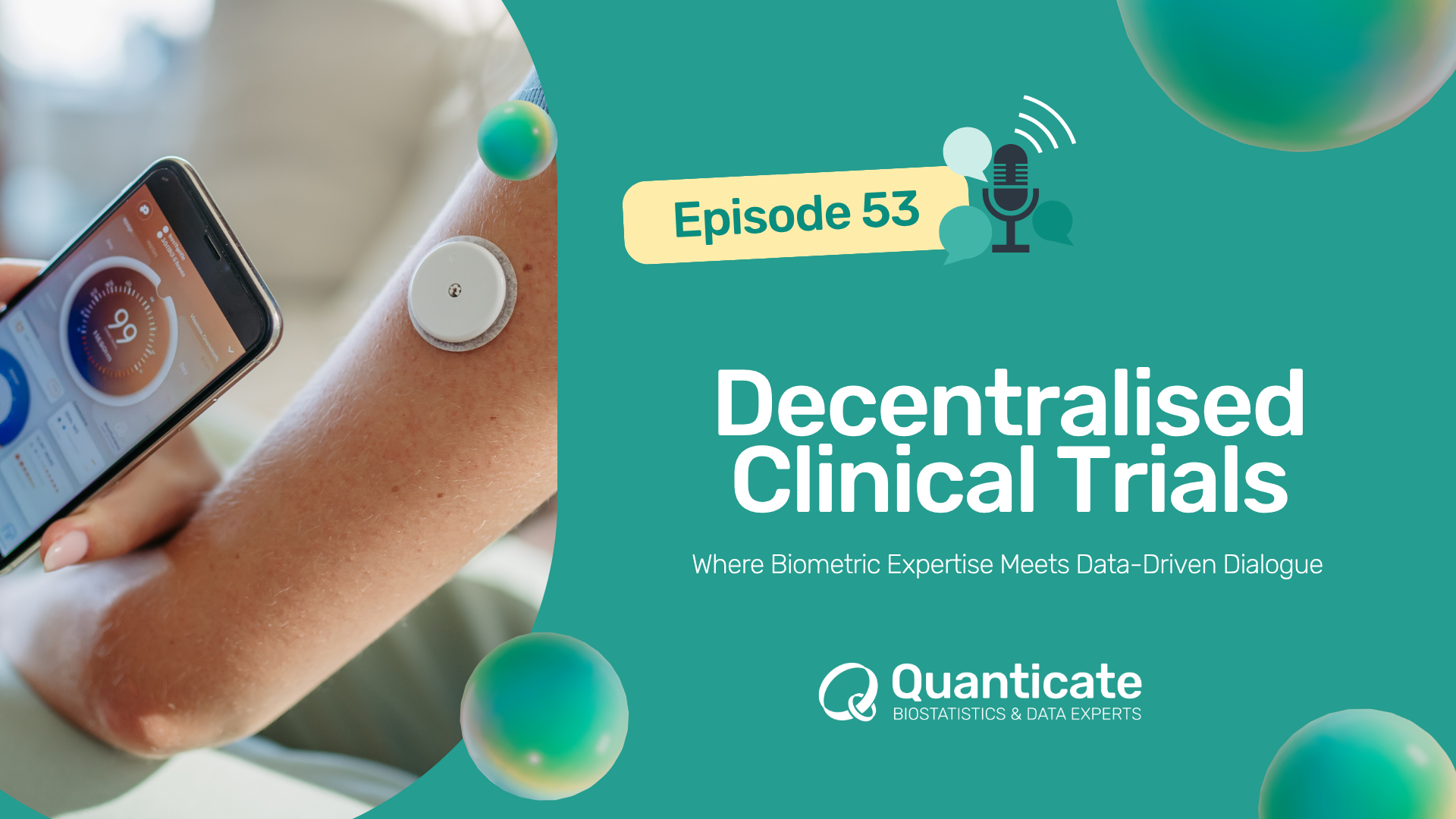
Decentralised clinical trials are often described as remote or digital trials, but the reality is usually more practical and more nuanced. In this QCast episode, co-hosts Jullia and Tom discuss decentralisation as a spectrum, where selected activities may move closer to the participant while site-based visits remain in place where clinical oversight is needed. That might include ePRO diaries, telemedicine, local sample collection, home nursing, wearable data, or direct-to-patient supply.
The value of decentralised clinical trials depends on how well it is designed into the study. Remote options can reduce travel, support broader participation, and help capture data between site visits, but they can also create operational risk if responsibilities, data flows, escalation routes, and participant support are unclear. The practical question is not whether a study can include digital or remote elements, but whether those elements fit the protocol, endpoint strategy, safety model, and participant population.
🎧 Listen to the Episode:
Key Takeaways
Design decentralised elements before the study starts
Decentralised activities should be planned as part of the protocol and operating model, not added after the main study design is already fixed. A home nursing visit, ePRO diary, local lab sample, or telemedicine follow-up needs defined timing, ownership, review expectations, and fallback arrangements. Without that early planning, an activity that appears convenient can create confusion for participants, sites, vendors, and data teams.
Remote data needs context to be usable
Decentralised trials often create data from several sources, including EDC, eCOA, ePRO, wearables, telehealth records, local labs, and home nursing documentation. The value of that data depends on provenance, mapping, validation, access controls, audit trails, and reconciliation pathways. A wearable heart rate value, for example, is only useful if the study team knows when it was captured, how it relates to the visit schedule, and whether it feeds into an endpoint, safety review, or general monitoring.
Oversight remains central in a decentralised model
Moving activities away from the investigator site does not remove investigator responsibility for participant safety or protocol conduct. Delegated tasks need to be documented, local providers need appropriate training, and safety information must reach the investigator through a clear review and escalation route. Product supply, dosing changes, protocol deviations, and digital access also need careful control so that decentralisation reduces burden without creating avoidable risk.
Full Transcript
Jullia
Welcome to QCast, the show where biometric expertise meets data-driven dialogue. I’m Jullia.
Tom
I’m Tom, and in each episode, we dive into the methodologies, case studies, regulatory shifts, and industry trends shaping modern drug development.
Jullia
Whether you’re in biotech, pharma or life sciences, we’re here to bring you practical insights straight from a leading biometrics CRO. Let’s get started.
Tom
So today we’re looking at decentralised clinical trials. Before we get into the operational detail, can you give us a quick run down of what these are?
Jullia
A decentralised clinical trial is a study that uses remote, local, or digital elements so that some trial activities can happen outside the traditional investigator site. That might mean a video consultation, an electronic questionnaire, a home nursing visit, a wearable device, local sample collection, or direct-to-patient supply. Some studies are almost fully remote, but most sit somewhere in the middle, with site visits retained where they’re clinically necessary. That’s why it’s usually better to think of decentralisation as a spectrum, rather than assuming it means a fully virtual trial.
Tom
So it’s more so a different way of designing parts of the participant journey?
Jullia
Exactly. It’s a design choice. You look at the protocol, the endpoint strategy, the safety profile, the participant population, and then decide which activities can move closer to the participant without weakening oversight or data quality.
Tom
And I suppose that design choice has to be made quite early?
Jullia
Yes. If you add decentralised elements late, you can end up with activities that look convenient on paper but don’t quite fit the endpoint, the safety model, or the visit schedule. A participant might attend site for baseline assessment and key safety checks, but complete symptom diaries at home, have certain follow-ups by telemedicine, and use a local lab for routine samples.
Tom
That sounds more realistic than trying to move everything out of the site. Where does the benefit usually come from for participants?
Jullia
The clearest benefit is reducing participant burden. Traditional site-based research assumes people can travel regularly, arrange childcare, take time away from work, or manage transport without difficulty. Many can’t. When selected activities are remote or local, participation becomes more practical for people who live far from specialist sites or have caring responsibilities.
Tom
And does that feed into recruitment and retention?
Jullia
It can. If the study is easier to take part in, more people may be able to consider it, and those already enrolled may be more likely to stay engaged. But it’s not automatic. A remote process that’s confusing, unreliable, or poorly supported can create a different kind of burden.
Tom
Can you give an example of that?
Jullia
Take an ePRO diary for symptom reporting. On paper, it sounds simple. The participant enters symptoms into an app each evening. But the study needs to define the completion window, reminders, what happens if the diary is missed, how late entries are treated, and whether certain responses trigger site follow-up. Without that structure, the technology might capture a response, but the team may still struggle to interpret it or act on it.
Tom
I think that moves us into data, really. Decentralised trials can generate more data, but also more sources of data.
Jullia
They do, and that’s where clinical data management becomes central. You may have EDC data from sites, eCOA or ePRO data from participants, wearable data, telehealth records, local lab data, and home nursing documentation. Each data point needs a clear source, owner, timestamp, audit trail, and reconciliation pathway. Those data flows should be defined before the first participant is enrolled, including how discrepancies are detected, who resolves them, and when issues need escalation.
Tom
What tends to go wrong when that isn’t planned early enough?
Jullia
Fragmentation. Different vendors may capture similar information in different formats, or the data arrives without enough context. For example, a heart rate value from a wearable may not be useful unless you know when it was recorded, whether the device was worn correctly, how it maps to the visit schedule, and whether it belongs to an endpoint, a safety review, or general monitoring.
So the issue isn’t only whether the data is captured, but whether it’s usable. This depends on provenance, mapping, validation, access controls, and review expectations.
Tom
Now in a traditional site model, a lot of safety oversight happens around visits. What changes when activities move away from the site?
Jullia
The investigator still remains responsible for participant safety and protocol conduct. Decentralisation doesn’t dilute that responsibility. What changes is the route by which information reaches the investigator. If a home health nurse observes a concern, or an ePRO response suggests a safety issue, the study needs a documented pathway for review, follow-up, and decision-making.
Now as you can imagine, this feels like an area where delegation can become blurry. Therefore, delegated activities need to be defined before they begin. The protocol and operational documents should make clear which tasks can be performed remotely, which require investigator review, how local providers are trained, and how protocol deviations are handled.
Tom
But if the goal is to make trials more accessible, could all this extra structure make them harder to run?
Jullia
It can make set-up more demanding, yes. But the alternative is usually worse. If responsibilities are unclear, if vendors don’t integrate properly, or if remote data isn’t reviewed in time, then the trial becomes harder to manage once it’s live.
Tom
That coordination also reaches into product supply, doesn’t it? Sending study drug to a participant’s home sounds convenient, but I imagine it’s not suitable for every trial.
Jullia
No, the model should follow the product risk. Some investigational products may be appropriate for home delivery or local administration by a trained healthcare professional. Others need site-based administration because of storage, preparation, dosing, safety monitoring, or emergency support requirements. If product is supplied away from the main site, the documents should cover shipment, temperature control, receipt confirmation, storage, dosing support, return, disposal, and emergency contacts.
Tom
What might that look like operationally?
Jullia
Imagine a dosing change after a safety review. The site, supply vendor, participant, and possibly a home nurse all need aligned instructions. The IRT may need updating, the participant may need revised dosing guidance, and the data team needs to know how that change is reflected in the records. If those links aren’t clear, that creates safety, compliance, and data issues.
And there’s also the digital divide to consider. Decentralised trials are often presented as more inclusive, but technology can exclude people as well.
Remote options can broaden access, but only if they’re designed with real participants in mind. Some people may have limited connectivity, low confidence with digital tools, language needs, visual or mobility limitations, or no suitable device. Sponsors may need provisioned devices, low-bandwidth options, multilingual support, or local visit alternatives for critical procedures.
So as much as we’d like it to be the case, inclusion isn’t achieved just by offering an app. In fact, it can even become a barrier if it’s too complex or poorly supported. Participant support should be built into the model. That includes training, helpdesk routes, reminders that are useful rather than intrusive, and fallbacks when something doesn’t work.
Tom
Where do regulators sit in all of this?
Jullia
Regulators have given clearer expectations for decentralised approaches, but the underlying message is consistent with good clinical practice. Decentralised elements need participant protection, reliable data, appropriate monitoring, secure systems, clear responsibilities, and transparent documentation. The standard doesn’t drop because an assessment happens remotely.
Sponsors need to show that systems are suitable, data handling is secure, responsibilities are documented, and oversight is maintained. Requirements such as data protection, system validation, audit trails, and risk-based quality management still apply.
Tom
What are the main takeaways for a sponsor considering decentralised elements?
Jullia
Start with feasibility, not technology selection. For each remote or local activity, check whether it reduces burden without compromising safety, endpoint quality, or protocol adherence. Then make sure the data source, review pathway, and oversight model are clear before the study starts.
If one of those pieces are weak then the trial may still run, but it will carry avoidable risk. You might see missed assessments, delayed query turnaround, unclear safety escalation, inconsistent source documentation, or protocol deviations that could have been prevented.
Tom
As we close, what’s the balanced view? Because decentralised trials clearly have benefits, but they’re not a universal fix.
Jullia
Well that’s precisely it. Decentralised trials can make participation more practical, support broader recruitment, and allow data capture between site visits. But they work best when remote, local, and site-based elements are selected deliberately. The strongest models keep clinical oversight visible and build the data and governance model around the way the study will actually run.
With that, we’ve come to the end of today’s episode on decentralised clinical trials. If you found this discussion useful, don’t forget to subscribe to QCast so you never miss an episode and share it with a colleague. And if you’d like to learn more about how Quanticate supports data-driven solutions in clinical trials, head to our website or get in touch.
Tom
Thanks for tuning in, and we’ll see you in the next episode.
About QCast
QCast by Quanticate is the podcast for biotech, pharma, and life science leaders looking to deepen their understanding of biometrics and modern drug development. Join co-hosts Tom and Jullia as they explore methodologies, case studies, regulatory shifts, and industry trends shaping the future of clinical research. Where biometric expertise meets data-driven dialogue, QCast delivers practical insights and thought leadership to inform your next breakthrough.
Subscribe to QCast on Apple Podcasts or Spotify to never miss an episode.


.png?width=110&name=ACDM_Corporate_Member_Badge_135%20(3).png)
.png?width=140&name=cdisc_gold_partner_80h%20(2).png)
