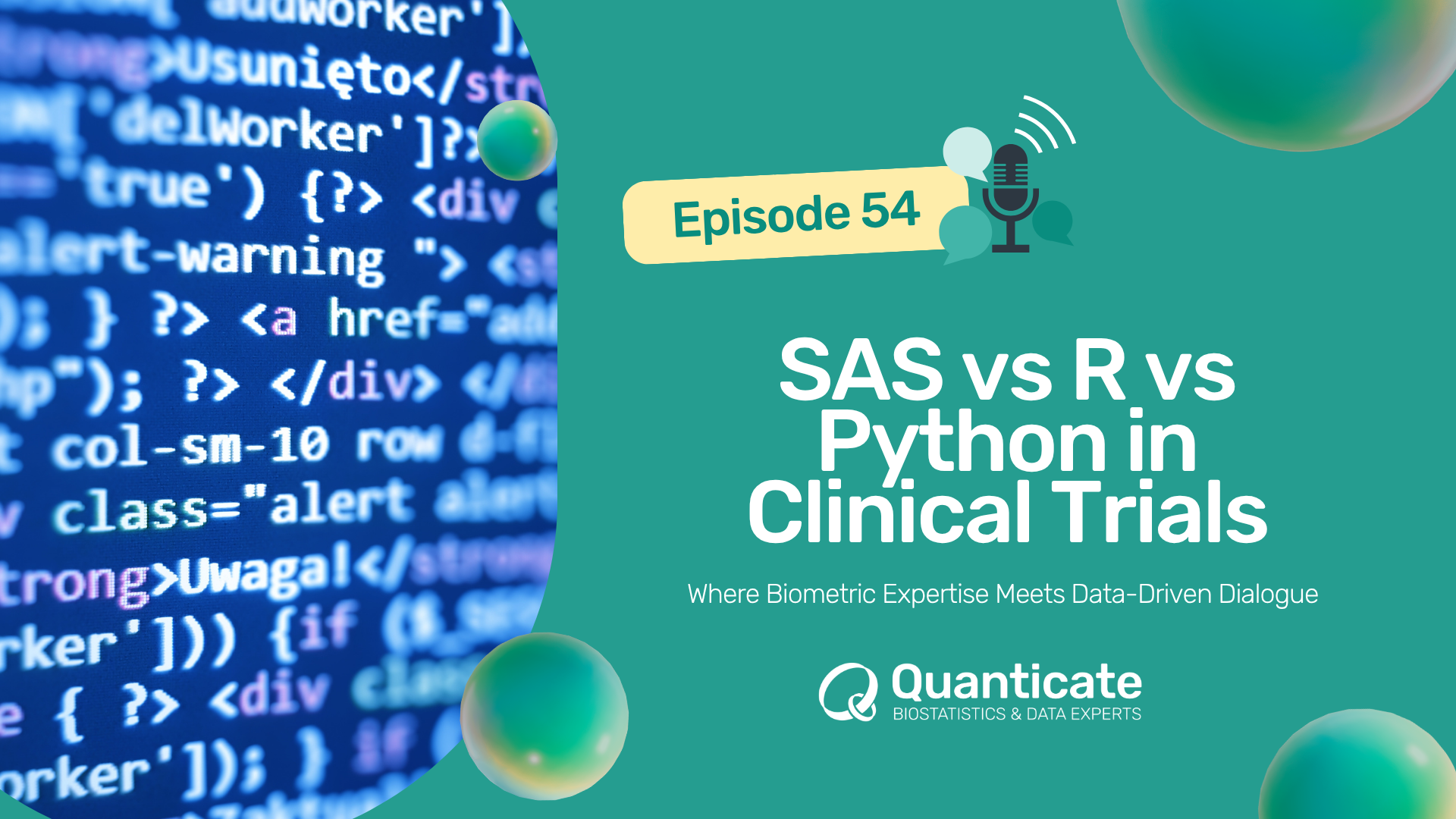
SAS vs R vs Python is often framed as a software debate, but in clinical trials it is more useful to ask which tool fits which part of the workflow. In this QCast episode, co-hosts Jullia and Tom explore how SAS, R, and Python are used across clinical reporting, statistical analysis, automation, data integration, and broader data science activity. The practical issue is not whether a tool can produce an output, but whether that output is suitable for the purpose it serves.
That distinction matters when work moves from exploratory analysis into regulated delivery. A safety listing used in regular adverse event review, for example, needs consistency and a clear review route. An R visualisation may help identify a trend, while a Python pipeline may support data movement or automated checks, but teams still need to understand how each output was created, controlled, and used. Getting this right helps avoid confusion around handovers, version control, validation, and whether a result can stand up to review.
🎧 Listen to the Episode:
Key Takeaways
SAS, R, and Python serve different parts of the clinical workflow
SAS remains closely associated with standardised clinical reporting, including CDISC datasets, tables, listings, and figures. R is widely used for statistical modelling, visualisation, and methods development, while Python is often used for data engineering, automation, integration, and machine learning workflows. The distinction is practical: each tool can contribute value, but the intended use should guide where it fits.
Governance matters more than the software label
Regulatory-facing work depends on reproducibility, documentation, validation, review, and control. Open-source tools do not make a workflow less valid by default, and commercial tools do not make a workflow compliant by default. What matters is whether the team can explain the data source, the computing environment, the code, the versions used, and the checks applied.
Mixed-tool environments need clear ownership
Clinical teams may use SAS, R, and Python on the same study, but the interfaces between tools need careful management. If Python flags missing lab values or R highlights a possible safety pattern, the study team needs to know what happens next. Clear ownership, documented handovers, and agreed output use help prevent useful analysis from becoming an uncontrolled decision point.
Full Transcript
Jullia
Welcome to QCast, the show where biometric expertise meets data-driven dialogue. I’m Jullia.
Tom
I’m Tom, and in each episode, we dive into the methodologies, case studies, regulatory shifts, and industry trends shaping modern drug development.
Jullia
Whether you’re in biotech, pharma or life sciences, we’re here to bring you practical insights straight from a leading biometrics CRO. Let’s get started.
Tom
Today we’re talking about SAS vs R vs Python, which for clinical teams, is really a practical question, isn’t it? Which tool fits which part of the trial workflow.
Jullia
Yes. It’s all about asking what the work needs, which is submission-ready reporting, exploratory analysis, automation, or data integration. SAS, R, and Python can all analyse data, but they’re built around different assumptions, and those assumptions affect day-to-day delivery.
Tom
So before we get into where each one fits, can we set out the basic difference between them?
Jullia
SAS is a commercial analytics platform, and in clinical trials it’s long been associated with structured programming, standard reporting, and regulated delivery. It has predefined procedures and a controlled environment, which is why many teams still rely on it for CDISC datasets, tables, listings, and figures. R is an open-source language built around statistical computing. It’s very strong for modelling, visualisation, and methods development because teams can extend it through packages. Python is broader again. It’s a general-purpose programming language, so it often comes into clinical workflows through data engineering, automation, integration, and machine learning rather than only through statistical analysis.
Tom
That helps. And I suppose one misconception is that because all three can analyse data, they’re interchangeable. Is that too simplistic?
Jullia
There’s overlap, but the operating model is different. In a clinical trial, the question is whether the result can be reproduced and explained.
Tom
Can you give an example of that difference? Maybe something that would show up during a live study rather than at the end.
Jullia
Think about adverse event review. A data manager might need a clean listing that shows adverse event term, onset date, severity, relationship to study treatment, action taken, and whether the event is serious. If that listing feeds regular safety review, the team needs consistency each time it’s run. SAS is often used for that kind of standardised output. R might be used alongside it to explore patterns visually, perhaps looking at onset timing by treatment group or severity over visits. Python might sit upstream or alongside the process, helping automate data transfers, connect systems, or prepare files that need to move between platforms.
Tom
I think that brings us to regulators. People sometimes ask, “Will regulators accept R?” or “Do we have to use SAS?” How would you answer that without over-simplifying it?
Jullia
Regulators are generally concerned with the integrity of the analysis, not loyalty to a particular software tool. The important things are traceability, reproducibility, validation, documentation, and control. Can you show where the data came from? Can you show how the output was created? Can someone rerun the analysis and get the same result? Can you explain the computing environment, the versions used, and the checks applied?
Tom
So the tool doesn’t remove the need for governance?
Jullia
No, and that’s a crucial point. Open-source tools don’t make a workflow less valid by default, and commercial tools don’t make a workflow compliant either. The process around the tool matters. For R, that may mean controlled package management, locked environments, code review, and clear documentation. For Python, it may mean the same, plus additional attention to pipelines, APIs, and how data moves between systems. SAS still needs proper validation and review as well. Familiarity helps, but it isn’t a substitute for control.
Tom
You mentioned packages there. Is that one of the practical differences between SAS and R?
Jullia
Yes, I’d say so. SAS tends to follow a procedural model. Programmers often work through DATA steps and predefined procedures, which supports repeatable reporting and a common way of working across teams. R is more function and package driven. You build analyses by combining functions, and you can bring in packages for very specific statistical methods or visualisations. That flexibility is useful, but it means the team needs to manage variation.
Tom
Would that show up in something like a dosing change or a protocol deviation review?
Jullia
Yes, it could. Suppose a protocol amendment changes a visit window or introduces a new dosing rule. In a standard SAS reporting workflow, the change may be handled through an existing programming and validation process, with updates to specifications and outputs. In R, the same change can be handled well, but the team needs to be clear about which functions are affected and how the update is tested. Python may be involved if the change affects a data pipeline, such as how dosing records are imported, transformed, or reconciled before analysis.
Tom
There’s also the cost and access question. SAS licensing is commercial, while R and Python are open source. Does that make the decision straightforward for smaller teams?
Jullia
It influences the decision, but it doesn’t settle it on its own. Open-source tools are easier to access, and that can be attractive for smaller sponsors, academic groups, or teams building exploratory workflows. But the cost of the software is only one part of the picture. You still need people who can program well, review the work, maintain the environment, document decisions, and support the workflow if something breaks. A free tool used without control can become expensive in other ways.
Tom
Right, because the hidden cost is in capability and process.
Jullia
Exactly. And the opposite can also be true. A licensed platform may have a direct cost, but if the organisation already has trained programmers, validated macros, standard operating procedures, and established delivery models, then it may be efficient for submission work. The practical answer depends on the team’s maturity, not just the price of the tool.
Tom
Where does Python fit for clinical teams that are mainly thinking about statistics and reporting? Is it competing with R there?
Jullia
Sometimes it’s presented that way, but in clinical development they often play different roles. R remains very strong for statistical modelling, research-driven analysis, and visualisation. Python is more commonly used where clinical data needs to connect with wider technology systems. That might mean automating file checks, building data pipelines, integrating with APIs, or supporting machine learning workflows. It can touch analysis, but its strength is often around the infrastructure that supports analysis.
Tom
Could a clinical team use all three on the same study without making things overly complicated?
Jullia
They can, and many do, but the interfaces need to be managed carefully. You might have SAS producing SDTM and ADaM datasets and final TFLs. R might support exploratory modelling or visual review during study conduct. Python might automate data movement, run checks on incoming lab uploads, or support dashboards and pipelines. That can work well when responsibilities are clear. It becomes risky when outputs move between tools without documented handover, version control, or review. It also means the people using those outputs need to understand what they are looking at. If a Python check flags missing lab values or an R visualisation highlights a possible issue, the study team needs a clear route from that finding to the next action, whether that is a query, a data review discussion, or no action at all.
Tom
So if a listener is trying to place SAS, R, and Python in their head, what’s the cleanest way to think about it?
Jullia
SAS is still strongly associated with standardised, regulated clinical reporting, especially CDISC datasets and submission-ready outputs. R gives teams flexibility for statistical analysis, modelling, visualisation, and increasingly controlled submission-related work where the right governance is in place. Python is valuable for automation, data engineering, integration, and broader data science workflows.
Tom
You said “increasingly controlled submission-related work” for R. Does that mean R is replacing SAS?
Jullia
In some areas, R is taking on work that would historically have been done in SAS, but “replacement” is too blunt. Many organisations are adopting R incrementally. They may begin with exploratory analysis, then reproducible reports, then controlled pilots, and only later consider regulatory-facing outputs. Full replacement depends on governance, infrastructure, validation strategy, and team capability. For many sponsors, coexistence is the more realistic model.
Tom
And what about the individual career question? People often ask whether they should learn SAS, R, or Python.
Jullia
It depends on the role they want to play. For clinical programmers focused on regulatory deliverables, SAS remains important. For statisticians and researchers, R is highly valuable because of its statistical ecosystem. For people working in automation, data pipelines, artificial intelligence, or system integration, Python is very useful. Increasingly, the strongest profile is not one language in isolation, but enough fluency to work across tools and understand the governance expectations around each one.
And this is a useful distinction, because learning syntax is only part of it. In clinical trials, a good programmer also needs to understand data standards, study design, validation, review cycles, and the consequences of errors. A small programming decision can affect a table, a listing, a data review meeting, or a submission package.
Tom
So really, the decision is less technical than people sometimes think?
Jullia
It’s technical, but also organisational. The most mature teams are usually not asking which language is best in the abstract. They’re asking where each one fits, what level of control it needs, and whether the output will stand up to review.
With that, we’ve come to the end of today’s episode on SAS vs R vs Python. If you found this discussion useful, don’t forget to subscribe to QCast so you never miss an episode and share it with a colleague. And if you’d like to learn more about how Quanticate supports data-driven solutions in clinical trials, head to our website or get in touch.
Tom
Thanks for tuning in, and we’ll see you in the next episode.
About QCast
QCast by Quanticate is the podcast for biotech, pharma, and life science leaders looking to deepen their understanding of biometrics and modern drug development. Join co-hosts Tom and Jullia as they explore methodologies, case studies, regulatory shifts, and industry trends shaping the future of clinical research. Where biometric expertise meets data-driven dialogue, QCast delivers practical insights and thought leadership to inform your next breakthrough.
Subscribe to QCast on Apple Podcasts or Spotify to never miss an episode.


.png?width=110&name=ACDM_Corporate_Member_Badge_135%20(3).png)
.png?width=140&name=cdisc_gold_partner_80h%20(2).png)
