
Clinical trials are designed to generate reliable evidence while balancing efficiency, cost, patient safety, and operational constraints. Traditional frequentist designs remain appropriate for many studies, particularly where fixed sample sizes and final analyses are well aligned with the clinical question. However, they can be less flexible when a study needs to learn from accumulating evidence or make planned decisions before the final analysis.
In Brief
-
Bayesian clinical trial design combines prior information with accumulating trial data to update evidence during a study.
- The approach can support planned decisions on efficacy, futility, dose selection, sample size and treatment arms before the final analysis.
- Bayesian methods often appear in adaptive trials, platform studies, rare disease research, dose-finding work and studies using external or historical data.
- Priors, borrowing assumptions and decision thresholds need clear justification because poorly specified assumptions can bias trial conclusions.
- The article explains how Bayesian designs are planned, simulated, reported and reviewed in clinical development.
What is Bayesian clinical trial design?
Bayesian clinical trial design is an approach in which prior information and accumulating trial data are combined within a probability model. As new data becomes available, the model updates the estimates of treatment benefit, harm, futility, or future success, allowing evidence to evolve throughout the study.
Practically, this means a Bayesian trial can be designed to answer questions such as:
- What is the probability that the treatment effect exceeds a clinically meaningful threshold?
- What is the probability that the trial will succeed if recruitment continues?
- How should historical or external data influence the current analysis?
- Should a dose, treatment arm, subgroup, or sample size be modified according to pre-defined rules?
Bayesian trial designs can be implemented in different ways depending on the level of Bayesian integration required. Fully Bayesian designs apply Bayesian methods throughout design, monitoring, and analysis, while hybrid designs combine Bayesian updating with frequentist operating characteristics such as Type I error evaluation. Regulatory and practical considerations often determine which approach is used in confirmatory versus exploratory settings.
Bayesian methodology is particularly valuable in adaptive, platform, rare disease, paediatric, and dose-finding studies, as well as trials that incorporate external or historical information. These settings often require efficient learning from accumulating evidence.
Bayesian methods are not the best choice for every study. They may add unnecessary complexity where the clinical question is straightforward, prior information is weak or contentious, or regulatory expectations strongly favour a conventional frequentist design.
Bayes' theorem in clinical trials: priors, likelihood, posterior, and prediction
Bayes’ theorem provides the mathematical basis for updating evidence in Bayesian clinical trial design. It describes how prior beliefs about a treatment effect are revised after observing new trial data. It combines what is known before the current data is analysed with what the current data shows.
In simplified form, Bayes’ theorem can be written as:
Posterior probability ∝ Prior probability × Likelihood
A more formal version is:
P(θ | data) ∝ P(data | θ) × P(θ)
In this expression, θ is the treatment effect or parameter of interest, P(θ) is the prior distribution, P(data | θ) is the likelihood, and P(θ | data) is the posterior distribution. In clinical trial terms, the updated estimate of treatment effect is shaped by both the prior information and the evidence generated within the current study.
The prior distribution represents information available before analysing current trial data. This may include evidence from earlier clinical studies, real-world data, mechanistic understanding, or structured expert knowledge. It may also include historical control data, registry evidence, or information from earlier phases of the same development programme, provided those sources are clinically and statistically relevant.
The likelihood function describes how the observed trial outcomes relate to different possible values of the treatment effect, depending on the chosen endpoint such as binary, continuous, or time-to-event outcomes.
By combining the prior and likelihood, the posterior distribution is obtained, which represents updated uncertainty about the treatment effect after observing the data. Posterior probabilities are commonly used to assess efficacy, safety, or futility at interim or final analyses, allowing evidence to be expressed directly in probabilistic terms rather than through indirect significance measures.
For example, a Bayesian analysis might estimate that there is an 88% posterior probability that a new treatment improves response rate compared with control, and a 72% posterior probability that the improvement exceeds a clinically meaningful threshold. A treatment may be more likely to be better than control, while still having less convincing evidence that the magnitude of benefit is sufficient to support the next development decision.
Bayesian methods also use posterior predictive distributions to estimate future outcomes if the trial continues or expands. Predictive probabilities help evaluate whether continuing recruitment is likely to change the final conclusion or whether sufficient evidence has already been accumulated. This supports interim decision-making in adaptive trial settings.
Posterior and predictive probabilities answer different questions. A posterior probability focuses on what the current data suggest about the treatment effect now. A predictive probability focuses on what is likely to happen by the end of the trial if it continues as planned.
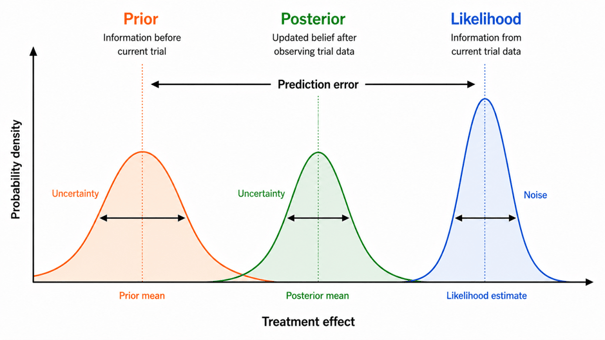
Figure 1: How Bayesian updating combines prior information with current trial data to produce a posterior distribution
Bayesian vs frequentist clinical trials: how uncertainty and evidence are interpreted
Bayesian and frequentist clinical trial frameworks differ in how they define and interpret uncertainty in treatment effects. In Bayesian analysis, probability represents uncertainty about the treatment effect itself, conditional on the model, prior assumptions, and observed data. This allows direct probability statements about treatment benefit, harm, or the likelihood that a clinically meaningful effect has been achieved. For example, a Bayesian analysis may conclude that there is a 92% posterior probability that the treatment effect exceeds a clinically meaningful threshold.
Frequentist methods treat treatment effects as fixed but unknown quantities, and uncertainty is evaluated through the behaviour of repeated hypothetical samples. Measures such as p-values and confidence intervals describe how data would behave under repeated experimentation rather than the probability of a treatment being effective.
The two approaches also differ in the interval estimates they produce. Bayesian analyses commonly use credible intervals, which describe the range within which a treatment effect lies with a specified posterior probability, conditional on the model and prior assumptions. Frequentist confidence intervals are interpreted in terms of long-run repeated sampling properties rather than the probability that a specific treatment effect lies within the interval.
These differences become especially important in interim monitoring and adaptive trial designs. Frequentist approaches typically require procedures such as alpha spending to control error rates across multiple analyses, while Bayesian approaches use posterior or predictive probabilities to evaluate accumulating evidence directly.
This can make interim decision-making easier to communicate, but the thresholds still need to be calibrated and justified. Bayesian probability statements are not a substitute for controlling decision risk.
The frameworks also differ in how external or prior information is used. Bayesian designs explicitly incorporate prior knowledge through probability distributions, while frequentist methods generally rely only on data generated within the current study. However, frequentist designs may still use historical information to inform design assumptions, such as expected variability, event rates, or clinically meaningful effect sizes. Bayesian modelling can also be useful where decisions depend on more than one endpoint, because joint models can estimate the probability that multiple clinical criteria are met together.
Both approaches are valid but serve different methodological and regulatory purposes depending on the trial context. In practice, frequentist methods remain widely used in confirmatory trials due to regulatory familiarity and long-established inference frameworks. Bayesian methods are increasingly adopted in adaptive, platform, and data-limited settings.
Neither framework is inherently superior. The appropriate choice depends on the clinical question, available evidence, regulatory context, and how the trial will use accumulating data.
Choosing and justifying priors in Bayesian clinical trial design
Prior distributions represent the starting assumptions about treatment effects before current trial data are analysed. They play a central role in Bayesian clinical trial design because they influence how quickly evidence is updated and how strongly early data impact conclusions. Careful prior specification is therefore essential for ensuring credible and balanced inference.
A well-chosen prior can improve estimation, stabilise inference, and make better use of existing evidence. Different types of priors are used depending on the level of prior evidence and the clinical context. Weakly informative priors allow the data to dominate the analysis with minimal external influence, while sceptical priors pull estimates toward no effect to reduce the risk of overstating benefit. Enthusiastic priors reflect stronger assumptions of benefit based on earlier supportive evidence, and robust or mixture priors are used to reduce sensitivity to extreme or uncertain assumptions.
Prior information can be derived from previous clinical trials, observational studies, meta-analyses, registries, or structured expert elicitation. In regulated settings, it is important that these sources are clearly justified and clinically relevant to the target population.
The choice of prior should reflect the strength, relevance, and reliability of the information available before the study. Important considerations include whether prior studies used comparable populations, endpoints, control conditions, and follow-up periods; whether the historical evidence is recent enough to reflect current clinical practice; whether the prior information is internally consistent or heterogeneous; and how sensitive the final conclusion is to alternative prior assumptions.
Prior elicitation can also be difficult in practice because different clinical or statistical experts may express different assumptions, particularly when the available evidence is limited or the sample size is small. In some cases, this may involve structured questionnaires or elicitation exercises with clinical experts, supported by preclinical evidence, disease knowledge, and historical information from similar trials. For this reason, the prior should be documented, justified, and tested rather than treated as a technical detail.
A key challenge in Bayesian design is prior-data conflict, where observed trial results differ substantially from prior expectations. In such cases, resistant or dynamic approaches can reduce the influence of prior assumptions to prevent misleading inferences. Sensitivity analysis is commonly used to evaluate how conclusions change under different prior specifications and to assess the stability of results.
A useful practical concept is effective sample size. This estimates how much information a prior contributes in terms comparable to additional trial participants. However, effective sample size is not simply the number of patients in historical studies, and historical literature does not automatically translate into a large effective sample size. Instead, it reflects how much usable information the prior contributes after accounting for relevance, precision, and consistency. If prior studies are inconsistent, imprecise, or poorly aligned with the current study, the practical information gain may be limited, and even a large historical dataset may contribute relatively little information to the current trial.
One simple way to express effective sample size is:
ESS = (between-subjects SD / SD of informative prior)²
This formula should be used only when the historical data are sufficiently comparable, and the informative prior has been constructed appropriately.
Using prior and external data in Bayesian trials
Bayesian clinical trial design allows formal incorporation of external or historical data into the analysis of current trial results. This process, often referred to as borrowing strength, can improve efficiency by supplementing limited trial data with relevant prior evidence. However, the validity of this approach depends strongly on the comparability of the data sources being combined.
External information may include previous clinical trials, historical control arms, registry data, real-world evidence, natural history studies, or earlier phases of the same development programme. Where a non-informative prior is used for the test treatment, historical trials using the same control may still help construct a prior for the control response.
A key requirement for borrowing is exchangeability, which assumes that the external data and current trial population are sufficiently similar in terms of patient characteristics, disease severity, endpoint definitions, and clinical practice. Comparability should also consider follow-up duration, geography, diagnostic criteria, standard of care, trial conduct, and timing. When this assumption is violated, direct borrowing can introduce bias and distort treatment effect estimates. For historical controls, this should include whether patients received the same clearly defined standard treatment and whether the historical study used similar inclusion and exclusion criteria.
Several statistical methods are used to control the degree of borrowing. Hierarchical and commensurate models allow information sharing based on similarity between datasets, while power priors and discounting approaches reduce the influence of external data when uncertainty or heterogeneity is present. Robust and mixture priors provide additional protection by limiting the impact of conflicting historical information.
Meta-analytic predictive priors may also be used when several historical studies are available. These approaches use the historical evidence to form a predictive prior for the current study, while allowing for between-study variability.
These approaches are particularly useful in rare disease trials, paediatric studies, and settings where recruitment is difficult or ethically constrained. However, inappropriate borrowing remains a major risk when external controls are not well aligned with the current study. This risk can be greater when nonconcurrent controls are used in adaptive or platform trials, because standards of care, eligibility patterns, or operational processes may shift over time. For this reason, extensive simulation and sensitivity analyses are typically required to evaluate the impact of external data on trial conclusions.
External borrowing should be treated as a design choice. Sponsors need to justify the relevance of external data, the degree of borrowing, the methods used to control borrowing, and how conclusions change under alternative assumptions.
Historical data are often used informally when planning a trial, for example to estimate variability, event rates, recruitment assumptions, population size, or a clinically relevant effect size. Bayesian borrowing is different because it formally incorporates external evidence into the analysis model, which means the assumptions behind that borrowing need to be explicit and tested.
Bayesian adaptive trial design and interim analyses
Bayesian methods are naturally suited to adaptive clinical trial designs because they allow evidence to be updated at planned points as data accumulate. This enables interim decisions to be based on current information rather than waiting for a fixed final analysis.
Interim analyses in Bayesian trials typically rely on posterior or predictive probabilities to guide decisions. These probabilities can be used to assess whether there is sufficient evidence of efficacy, whether continuation is unlikely to be beneficial, or whether the trial is on track to meet its objectives. This supports early stopping for success or futility based on predefined criteria. Stopping for futility can also help avoid continued recruitment into a study that is unlikely to answer its primary question, reducing unnecessary patient exposure and resource use.
Furthermore, an interim analysis may show a high posterior probability that the treatment is better than control based on the data observed so far, but a lower predictive probability of final success if the remaining recruitment is unlikely to resolve uncertainty. In that situation, a data monitoring committee may need to consider whether continuing the trial is scientifically and ethically justified.
The main risk is that the trial makes the wrong interim decision. A study could stop for futility when the treatment is genuinely effective, or stop early for success when later evidence would not support the same conclusion. Simulations help estimate how often these decisions could occur under different assumptions about the true treatment effect.
Example Bayesian decision rules may include:
| Bayesian quantity | Example decision rule | Practical interpretation |
| Posterior probability of benefit | Stop for success if Pr(treatment benefit > 0) > 0.99 | Current data provide strong evidence that the treatment is beneficial |
| Posterior probability of clinically meaningful benefit | Continue only if Pr(effect > MCID) remains above a pre-defined threshold | The effect is likely to be large enough to be clinically meaningful |
| Predictive probability of final success | Stop for futility if predictive probability of success < 0.10 | The trial is unlikely to reach a positive conclusion if it continues |
| Posterior probability of harm | Pause or review if Pr(safety risk exceeds threshold) is high | Safety evidence may require further review |
Note: The thresholds shown above are for illustrative purposes only
Beyond stopping rules, Bayesian adaptive designs can include modifications such as sample size re-estimation, treatment arm dropping, subgroup enrichment, or response-adaptive randomisation. These features are especially relevant in platform and multi-arm trials where multiple therapies are evaluated within a single infrastructure. They allow the design to evolve while maintaining statistical coherence when adaptations are prospectively defined and operationally controlled.
Decision rules are typically based on probability thresholds applied to key quantities of interest. The choice of thresholds depends on clinical context, disease severity, and acceptable levels of risk.
Adaptive designs also introduce challenges. Multiplicity, delayed outcomes, treatment-by-time interactions, temporal drift, and the use of non-concurrent controls can all affect inference when trial arms change over time. These issues require careful modelling, pre-specification, controlled access to interim data, and simulation-based evaluation before the trial begins.
The protocol should specify what can change, when it can change, who sees the interim results, and how each decision will be implemented. For blinded or adaptive studies, interim analyses may also require independent statisticians or programmers, an independent data monitoring committee, and a charter covering roles, access to unblinded data, decision processes, confidentiality, and communication pathways.
Operating characteristics, sample size, and design evaluation
Bayesian clinical trial designs are evaluated primarily through simulation rather than fixed analytical sample size formulas. This is because adaptive rules, prior distributions, and complex models make closed-form calculations impractical in most realistic trial settings. Simulation therefore becomes the central tool for assessing design performance before implementation.
These simulation studies are sometimes described as virtual trials because they test how the proposed design would behave repeatedly under different assumptions before the actual trial is run.
Simulation studies are used to evaluate how a design behaves across a range of plausible clinical scenarios. These scenarios typically include different assumptions about treatment effects, variability, and patient populations. They should also test recruitment patterns, missing data, delayed outcomes, external-data conflict, and population heterogeneity where these are relevant to the design.
Key operating characteristics include the probability of correctly identifying an effective treatment, the probability of incorrectly declaring success, expected sample size, and the probability of early stopping. Depending on the design, they may also include the probability of selecting the correct dose, dropping an ineffective arm, identifying a responsive subgroup, or borrowing too much from historical data.
Where possible, simulations should test decisions against clinically meaningful effect thresholds, not only statistical success thresholds, because the design should show how often it supports the right clinical decision under plausible treatment effects.
The clinically meaningful threshold should be set before the study begins. It may be informed by the current standard of care, input from clinical experts, competitor data, commercial considerations, and the sponsor’s development strategy.
Sample size assessment may distinguish between the maximum planned sample size, the expected sample size under specific scenarios, and the average sample size across simulated trial paths. These metrics help quantify the trade-off between efficiency and statistical reliability.
In Bayesian adaptive trials, sample size is often better understood as a distribution of possible trial paths rather than a single fixed number. A design may have a maximum planned sample size, an expected sample size under each scenario, and a range of possible sample sizes depending on interim decisions.
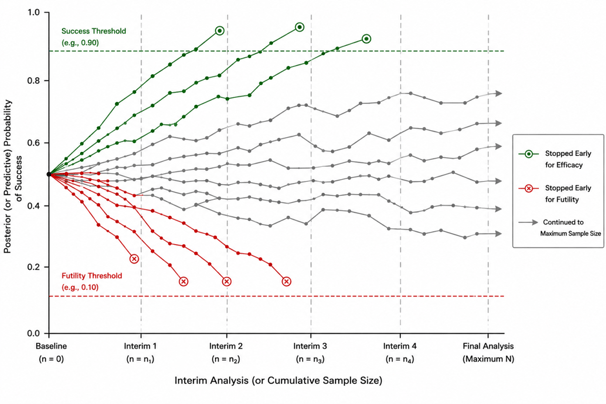
Figure 2: Example simulated trial paths showing how Bayesian decision rules may lead to early stopping, continuation, or maximum sample size
Decision thresholds for efficacy, futility, and adaptation are usually calibrated through repeated simulation. Clinical simulation can also help determine when interim analyses should occur, not only what the decision thresholds should be. This process ensures that posterior or predictive probability cut-offs achieve an appropriate balance between patient safety, statistical rigour, and operational feasibility. Sensitivity to design assumptions is also assessed by testing performance under conditions such as missing data, delayed responses, or population heterogeneity.
The simulation plan should be reproducible and sufficiently detailed for review. It should describe the scenarios tested, assumptions used, number of simulated trials, decision criteria, missing data assumptions, and outputs used to judge design performance.
Bayesian clinical trial design and regulatory acceptance
Regulatory acceptance of Bayesian clinical trial designs depends on whether the proposed approach is transparent, well-defined, and demonstrates reliable operating characteristics. Agencies such as the FDA and EMA do not require a specific statistical framework, but they expect evidence that the chosen design supports valid and reproducible conclusions.
A key regulatory requirement is full pre-specification of the design components. This includes prior distributions, statistical models, interim analysis schedules, and decision rules. Adaptive features must be defined in advance to ensure that trial conduct is not influenced by post hoc decisions or unplanned modifications. This helps maintain trial integrity.
Simulation-based evaluation plays a central role in regulatory review. These simulations are used to assess operating characteristics such as type I error control, probability of correct decision-making, and expected sample size across multiple scenarios. Regulators typically expect evidence that the design performs consistently under both optimistic and conservative assumptions.
Justification of prior information is also critical in regulatory settings. Sponsors must demonstrate that external or historical data are relevant to the target population and do not introduce bias into the analysis. Sensitivity analyses are often required to show that conclusions remain stable under alternative prior assumptions.
Regulatory context should also be separated by product type and guidance status. FDA’s medical device guidance has long addressed Bayesian statistics in device clinical trials, while FDA’s 2026 draft guidance for drugs and biologics reflects broader use of Bayesian methods in areas such as interim adaptations, external or nonconcurrent controls, dose selection, subgroup analysis, and primary inference. Draft guidance should be treated as current regulatory direction rather than finalised policy.
For drugs and biologics, current FDA draft guidance places particular emphasis on prior distributions, informative priors, estimands, missing data, software, computation, documentation, reporting, and operating characteristics. Sponsors should therefore be prepared to explain not only the Bayesian model, but also how the design behaves under plausible and unfavourable scenarios.
For more complex designs, the regulatory package may also need to explain the decision framework, including how benefits, risks, uncertainty, and stopping or adaptation rules are weighed.
Bayesian methods also do not remove the need for core trial safeguards. Randomisation, blinding, concurrent controls where appropriate, clear endpoint definitions, and bias control remain important design features. Bayesian methodology changes how evidence is modelled and updated; it does not replace sound clinical trial design.
Early regulatory engagement is advisable for designs involving adaptive decision-making, external controls, nonconcurrent controls, informative priors, platform infrastructure, or Bayesian primary inference.

Implementation and reporting considerations
Implementing a Bayesian clinical trial design requires substantial upfront planning compared with traditional fixed designs.
Successful implementation depends on close collaboration between statisticians, clinicians, and operational teams. Statisticians define priors, models, and decision rules, while clinicians ensure that these assumptions are clinically meaningful and aligned with therapeutic goals. Operational teams support data management, interim analysis execution, and adaptation workflows during the trial.
From a computational perspective, Bayesian designs often rely on simulation engines and numerical methods such as Markov Chain Monte Carlo to estimate posterior distributions and evaluate operating characteristics. This requires validated software pipelines and reproducible analytical workflows to ensure consistency and reliability across analyses.
Depending on the model, analyses may use Markov Chain Monte Carlo, approximation methods, or custom simulation engines. The software and code used for simulation, interim analysis, and final analysis should be documented, version controlled, and validated according to the study context.
For complex Bayesian models, teams should also plan how outputs will be quality controlled. This may include convergence checks, review of posterior distributions, and sense checks against simpler models where appropriate.
Model checking is also part of practical implementation. Bayesian clinical trial designs rely on explicit statistical models that describe how outcomes, variability, covariates, and treatment effects are related. Posterior predictive checks can be used to compare observed data with data simulated from the fitted model, helping assess whether the model reproduces key features such as event rates, distributional shapes, or survival patterns.
Assumption assessment then tests whether conclusions remain stable when model assumptions change. This may include alternative likelihood specifications, different variance structures, or variations in hierarchical modelling choices. Unlike prior sensitivity analysis, which focuses on external information, this step evaluates the stability of the statistical model itself.
Reporting requirements are also more structured than in traditional designs. Trial protocols and statistical analysis plans must clearly specify all priors, models, interim analyses, and decision criteria.
Bayesian results also need careful explanation for different stakeholders. Clinicians may need probability statements framed around treatment benefit and clinical relevance, while monitoring committees may need concise summaries of efficacy, safety, or futility probabilities. Regulators generally require fuller documentation of model assumptions, prior specifications, sensitivity analyses, and simulation-based operating characteristics.
Clear reporting should avoid presenting posterior probabilities as absolute facts. They are model-based estimates, conditional on the data, prior assumptions, and statistical structure used in the analysis. Good reporting balances interpretability with enough technical detail for review and reproducibility.
Bayesian results should therefore be framed as conditional probability statements, not absolute truths. This distinction is important for clinicians, oversight committees, regulators, and sponsor teams making development decisions.
Conclusion
Bayesian clinical trial design provides a structured framework for updating evidence as data accumulate during a study. Its main value lies in making assumptions explicit, incorporating relevant prior information where justified, and using probability-based decision rules that can be evaluated before the trial begins. For sponsors, the practical question is not whether Bayesian design is more modern than frequentist design. The better question is whether it improves the trial’s ability to answer the clinical question reliably, ethically, and efficiently.
FAQs
Can prior data be used in a Bayesian trial?
Yes. Bayesian methods can incorporate historical or external data through approaches such as power priors, commensurate priors, hierarchical models, meta-analytic predictive priors, or robust mixture priors. The key issue is whether the external data are sufficiently comparable with the current trial population, endpoints, and standard of care.
Are Bayesian trials accepted by regulatory authorities?
Yes. Bayesian methods can be acceptable when designs are pre-specified, transparent, and supported by simulation showing reliable operating characteristics. Sponsors should also justify priors, document decision rules, and assess sensitivity to alternative assumptions.
What types of studies benefit from most Bayesian designs?
Bayesian designs are often useful in rare disease, paediatric, early-phase, adaptive, platform, dose-finding, and external-control settings. They are most appropriate when planned learning, evidence integration, or interim decision-making adds clear value.
Is the analysis in a Bayesian trial more complex?
Bayesian analysis can be more complex because it requires careful prior specification, simulation, model checking, and operational planning. However, the outputs can be easier to interpret when they are presented as probabilities of benefit, harm, futility, or future success.
Can Bayesian designs include randomisation and blinding?
Yes. Bayesian methodology changes how evidence is modelled and updated; it does not replace standard safeguards such as randomisation, blinding, concurrent controls where appropriate, clear endpoint definitions, and bias control.
Do Bayesian designs reduce sample?
They can reduce the required sample size in some settings, particularly when relevant and consistent prior information is available. However, sample size savings are not guaranteed. If historical data are inconsistent or poorly aligned with the current study, the effective information gain may be small.
Quanticate’s statistical consultancy team supports sponsors with Bayesian clinical trial design strategy, prior justification, simulation planning, adaptive decision rules, historical data borrowing, and regulatory-ready statistical documentation. If you are considering whether Bayesian methods are appropriate for your study, or need support to plan, justify, and implement a Bayesian design, request a consultation today.




.png?width=110&name=ACDM_Corporate_Member_Badge_135%20(3).png)
.png?width=140&name=cdisc_gold_partner_80h%20(2).png)
